The Power of Crystals

Crystals are widely used within the pagan and spiritual communities as tools for healing, spell correspondences, magical tool, or accessories. There are plenty of people who use them, and a quick Google search will show many recommendations which crystal should be used for a headache, to aid motivation, to improve psychic powers, as well as its correspondence to plants, chakras, zodiac signs, elements, etc. Unfortunately, not all of these suggestions are congruent.

So do crystals work and, if so, where does their power come from? That entirely depends on your life philosophy. A common belief is that crystals vibrate on a certain frequency, which may be the right frequency to help us in a particular time. They are seen as absorbers and transmuters of energy, that work through rebalancing the biomagnetic field that surrounds the physical body and bring chakras back into balance. Opinions may vary on whether crystals need to be programmed to do their task, or whether their nature already dictates their programming and speciality (Brown, 2007; Hall, 2009).

Selenite point.

Another explanation points to the sacred geometry within the structure of the crystals, which then filters the energy around us a certain way. Some argue that they are Divine gifts, designed to aid us on our spiritual paths, and therefore only tend to work who people already on this path, as such people are able to feel and connect with their energy (David & Heath, 2013).

On the other hand, an animist would argue that it is not the crystal, but rather the spirit of the crystal that’s important. It is through forging these relationships with spirits around us that we are able to benefit from their aid. This would mean that rather than a type of crystal being beneficial for a specific thing, the spirit of that particular gem or stone may be willing and able to help us, and this may differ even for two crystals of the same type. The argument here is that the crystal is a being in its own right (Hall, 2009).

Sceptics of course would argue that there is nothing more to crystals than a simple placebo effect โ€“ which in its own right can be quite powerful, even if known to be a placebo. That may very well be. They may also point out that some of the common crystals are actually synthetically made and therefore cannot naturally possess the assigned healing properties. Some of the explanations propose a way around that, since even a synthetic stone will have its own structural pattern or a spirit. It may even be that all of the aforementioned explanations are in some way true.
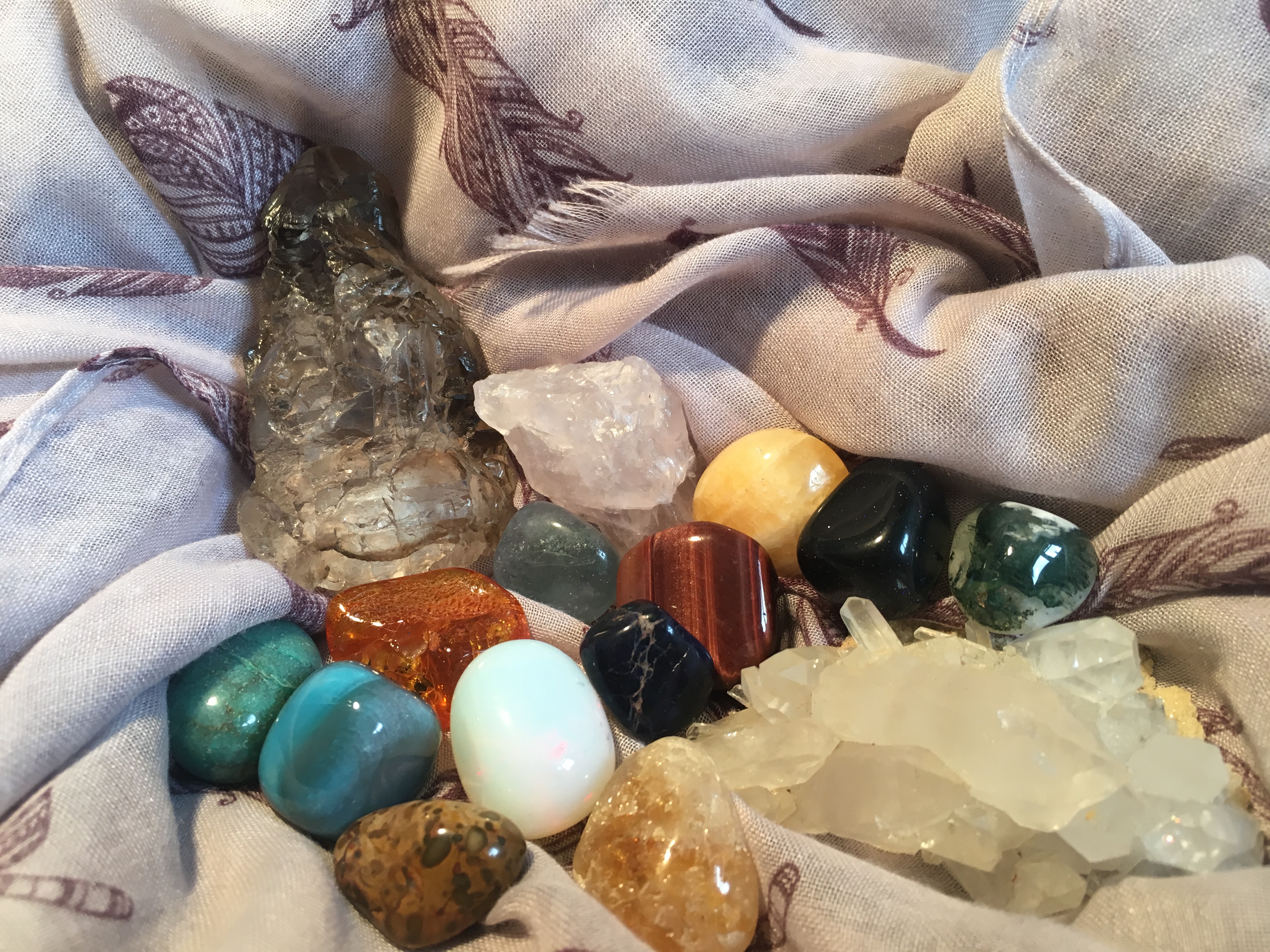
Some of my collection.

Over time I have come to appreciate that, no matter which explanation is right, both natural and man-made crystals do tend to work well for me, and I stopped worrying about why that is. There are a few I particularly enjoy working with, but my method of choosing one for the day is random. All of my crystals are in their individual velvet bags, tucked away in a box. When I feel I need something ‘extra’, I pick a bag my hand is drawn to without looking. Interestingly, I found that the properties of the stone I choose reflect what I need that day, for example randomly choosing a red tiger’s eye when I’m feeling low in energy. I also really enjoy meditating with them and I’ve had some wonderful experiences with personal gnosis about their properties. Admittedly these may sometimes differ from the standard properties discussed, but it works for me. Maybe this comes down to the relationship with the individual crystal or spirit? Either way, I know that I will happily continue exploring my crystal journey for a while longer.

References:
David, J., Heath, V. (2013). Tiers of Light. Shrewsbury:The Torch Publishing.
Hall, J. (2009). The Crystal Bible Vol.1. London: Octopus Publishing Group Ltd.
Brown, D. (2007). Beginner’s Guide to Crystals. Leicester: Silverdale Books.

Rosemary

Rosemary (Rosmarius Officinalis) is another common herb you may find in your garden, or at least in your spice cupboard. Its Latin name means โ€œsea-dewโ€and may refer to the plant’s appearance and preference to grow close to the sea.

Rosemary tends to be easier to cultivate from cuttings than from seeds. It needs a well-drained soil and a sunny spot in the garden. Don’t cut it back in autumn as it may not recover during frosts. It’s unlikely to suffer pests and can be harvested all year round (McVicar, 2010).

There are a few Christian legends associated with the plant. In one of the stories the plant gains its fragrance when Virgin Mary spreads baby Jesus’ clothes on its bush to dry. In another story Mary was resting during her journey to Egypt and hung her robes on a rosemary bush. When she removed them, the previously white flowers have turned blue (Linford, 2010). In a different version of the story Mary was hiding from soldiers, kneeling behind a rosemary bush with her cloak spread over it (McVicar, 2006).

My potted rosemary.

Rosemary is linked to memory and remembrance, as mentioned in Shakespeare’s โ€œOpheliaโ€. It is also seen as protective against evil in many cultures, and symbolic of friendship and love (Linford, 2010). Couples would carry rosemary as a sign of fidelity in Elizabethan times. Throughout history it was often used to freshen and cleanse air during sickness (McVicar, 2006), which links to its protective and cleansing qualities.

Rosemary essential oil has anti-bacterial and anti-fungal properties, and can be rubbed onto joints to help poor circulation. It can be applied externally to the forehead to aid headaches, or a few drops can be added to a bath to soothe muscles and help lift mood, however it should not be used internally. Rosemary tea, on the other hand, can be drunk in small doses to aid digestion or used as mouthwash. Care should be taken, as extremely large doses of rosemary can be dangerous and have the potential to cause abortions and convulsions (McVicar, 2006; Plucknett,1996).

Traditionally, we can see that rosemary was used for love and fidelity, thus we can incorporate it in those spells if needed, or hand-fasting rituals. There are also potent purifying and protective properties which can be used in smoke cleansing, protective charms and wards. This can include incorporating sprigs of the herb or anointing objects with its essential oil. Lastly it can be used to aid memory when studying, in spells linked to memory or learning, and by extension to aid dream recall.

References:
McVicar, J. (2006). Jekka’s Complete Herb Book. Leicester: Silverdale Books.
Linford, J. (2010). A Concise Guide to Herbs. Bath: Parragon Book Ltd.
Plucknett. J. (1996). Traditional Herbal Remedies. Bristol: Parragon Book Service Ltd.

Plant Spirits and Allies

Animism is the belief that all things have a spirit. This can include spirits of places, such as meadows or forests, spirits of natural features, such as stones or plants, spirits of everyday objects, such as lamps or your house, etc. There can, of course, be some debate as to where one spirit ends and another begins. Is is that every room, or every wall, or every brick in every wall has its own spirit, or is it all of the above? If a plant reproduces to make more versions of itself, are those still the same spirit or are they new ones? Do they develop their individuality over time? Whatever your specific views may be, many agree that such spirits can make powerful allies if we build relationships with them.

In Shamanism, relationships with plant spirits are particularly important. They can provide valuable information and support when it is needed. The plant can reveal information on its healing properties, and the spirit itself an greatly aid the healing process. Some argue that experiences generated by certain natural psychedelic substances taken to aid shamanic journeys, are in fact messages from the plant spirits conveyed in the form of visions (Baghramian, 2015).

In order to learn from a plant spirit, one should find a plant they feel called to, observe it for a while, and begin talking to its spirit. Permission should be sought to take a part of the plant away, and this should be done in a respectful way which will not harm the plant. One can then journey to meet the plant spirit in non-ordinary reality and converse with it (Baghramina, 2015). Another method is to find a plant one is attracted to while holding their intention or question clear in their mind . An offering can be made to the plant, though it is important that it is suitable and does not harm the plant or wildlife around it. While sitting in a meditative state with the plant, attention should be paid to any messages that are received. These messages can be visual, auditory, kinaesthetic, or cognitive, and as such present themselves as seeing, hearing, feeling or knowing (Farmer, 2009).

Violas in my garden.

With time and patience, plant spirits can become allies who are willing to aid us in our endeavours. However, as with any relationship, there has to be some give and take, some reciprocity, and efforts should be made to maintain the relationship. With time, you may even be able to ask your plant spirit ally to perform certain tasks for you, such as warding your home for example (Sebastiani, 2017).

There are many ways to deepen our relationship with spirits and allies. So, in the spirit of making these alliances (terrible pun intended), why not challenge yourself to explore something different. May marks the beginning of the 30 Day Plant Spirit Ally Challenge, organised by Hagstone Publishing. I’m excited to try it!

References:
Baghramian, A. (2015). The Magic of Shamanism. Barcelona: Guid Publicaciones.
Farmer, S. D. (2009). Earth Magic: Ancient Shamanic Wisdom for Healing Yourself, Others and the Planet. London: Hay House UK Ltd.
Sebastiani, A. (2017). By Rust of Nail & Prick of Thorn: The Theory and Practice of Effective Home Warding. Smashwords Edition.

Common Sage

As a witch, you more than likely have stumbled upon the idea of smudging with sage, and maybe even done it yourself. Smudging is a Native American practice that uses white sage, and has recently been surrounded by much talk of cultural appropriation. Luckily, with over 750 species of sage out there, there are other choices.

Its Latin name Salvia comes from the word ‘salveo’, which means ‘to save’ and refers to the widely recognised medicinal uses of this plant. Salvia officinalis also known as Common Sage or Garden Sage, is probably the most commonly used type of sage in cooking, and therefore the most easily obtainable one.

It is a fairly hardy plant, able to survive most winters outside. Seeds should be planted in spring and are easy to grow, with little maintenance needed and no common pests or disease that you need to worry about. It needs full sun and well drained / dry soil.

My garden sage, in need of some TLC after winter.

Sage is an antiseptic. It can be made into a gargle when infused as a tea to aid sore throats and throat infections. However, drinking the tea for more than a week or two at a time can cause symptoms of poisoning due to the herb’s strength.

As witches, we also value its cleansing and protective properties. It can be used in a cleansing bath, before or after a ritual, or maybe even as a part of it. To infuse your bath simply add 7-8 drops of sage essential oil to a full bathtub. Alternatively, you can get a small bit of muslin or similar fabric and fill it with dried sage. Tie it with a string and attach to the tap, so that water flows through it as you’re filling your bath. Sage can also be grown, harvested and dried into a cleansing stick or burned as incense to cleanse your space. Personally, I like to cleanse the house every couple of weeks with it, as I find it really lifts the energy at home. Similarly, a couple drops of essential oil can be added to home made cleaning products, to obtain the same cleansing and protective effects. Other magical correspondences include healing, wealth and wisdom.


Resources for this post:
Jekka’s Complete Herb Book by Jekka McVicar
A Concise Guide to Herbs by Jenny Linford
Traditional Herbal Remedies by Jenny Plucknett
The Kitchen Witch by Soraya