Slavic Household Spirits โ€“ Part 2

Today, we continue exploring the different household spirits found across Slavic beliefs.

Boลผe Siedliczko was a benevolent house spirit who remained invisible, until there was danger approaching, at which point the spirit would appear before the residents warning them. The expectation was that the residents would then politely ask about the details of the events to come. Ignoring the warning would anger him and bring about his punishment. However, the spirit would never interfere to stop any tragedy. The only other thing that could anger him, was an accidental scalding with hot water. The spirit would then cause the clumsy resident to be punished with a red, painful rash. To prevent the spirit escaping and cure the rash, housewives would spread butter on the chimney and say โ€œBoลผe siedliczko, I anoint you, heal me when you have burnt meโ€.

Domovoy, from the Indo-European root โ€œdomโ€ for โ€œhomeโ€, was a household spirit, that was once a living kin to the family. The souls of those who passed away sometimes chose to stay to help the household. He looked like a small, old man with grey hair and a beard, in rugged, dirty clothes. He lived behind the stove and expected a daily offering of food for looking after the home, protecting it from evil and ensuring good fortune. He was also in charge of the other household spirits, ensuring they completed their work.

Domovoy

Kautki were only a few inches tall, but could bring good fortunes and prosperity to a household. However, their arrival may have not been obvious to the occupants, who had to be careful not to offend them. To move in, kautki would leave a โ€œgiftโ€ – this could be bits of string, broken shells or stones left on the floor, or bits of fluff in a jug of milk or beer. If this offering was not appreciated, the beings would leave offended, often setting the house on fire on their way out. If, however, the occupants didn’t clear away the gift and drunk the liquid without complaints, they presumed an agreement was struck. At night they would look after the cattle, help out in any house chores, and bring home valuable items. They would be given a daily portion of milk and oats, and after a few years the occupants would become significantly richer. At this point, kautki asked for a payment of red clothes, and would leave forever after receiving them.

Popielnik, translating to โ€œash panโ€ from Polish, was a spirit from pagan Slavic times. He was believed to be a protective household spirit of an ancestor, living within the hearth or a stove. He was a small, gnome like man with a head of a grey tabby cat. He needed to be shown respect, and at times of celebration would be paraded publicly to show the ancestors were looking after the tribes. If disrespected or annoyed, which he was easily, he could set the family’s home on fire and defend burnt down foundations, preventing anyone from rebuilding their homes. His irritability was caused by frequent burning of his feet inside the stove, which was seen as penance for sins committed during his life. To help him out, housewives would often leave a few wooden logs extra when baking bread so that the spirit could rest his sore feet away from the fire.

ลปyrownik was an obese little daemon, who lived in pantries ensuring that the residents enjoyed prosperity and had the luxury of excess food, if he was fed properly himself. Most often he was given cow milk, and thrown a celebratory banquet once a year. If this spirit was not fed well, either due to lack of means or laziness, he would lose weight rapidly and become weak, until he could no longer defend the household from evil spirits of poverty and misery.


References:
Bestiariusz Sล‚owiaล„ski (2018) by Witold Vargas and Paweล‚ Zych.

Slavic Household Spirits โ€“ Part 1

A plethora of spirits exists in Slavic lore and beliefs, ranging from those helpful spirits, to those who we would rather avoid, with many shades in between. This is the same for any setting, but today I would like to specifically focus on some of those helpful household spirits.

What follows is an overview of some of the spirits and daemons that benefit a household. As there are so many, this is part one with more to follow at a future date. Some of these are truly localised to one specific region within a country, but many can be found across multiple locations. A common theme between all helpful sprites seems to be the need to show them respect, an offer of a place to live, and regular food offerings which tend to consist of milk, stew or groat. I hope that these translated accounts bring some more awareness of these fantastic and often lesser known beings.

Photo by Alex Zelenko from Wikimedia Commons.

Aitwar was a dragon type spirit from Lithuania, with the body of a winged snake, a head of a bird, and a broom-like tail. In exchange for food and a place to live, he would fly through the chimney at night, looting treasures as well as everyday objects from the neighbours. From far away and against a black sky, a returning Aitwar would look like a shooting star. People would often cross themselves upon this sight, presumably to avoid misfortune, or maybe to avoid being chosen as the next target of the looting?

Baj, whose name is presumably linked to the Polish word โ€œbajkaโ€ meaning โ€œstoryโ€ or โ€œfairytaleโ€, would climb walls and ceilings of houses, singing lullabies to put children to sleep, in exchange for a daily portion of milk and groat.

Boลผฤ…tka (singular Boลผฤ…tko) had a much sadder origin story. These beings were created from souls of children, who died so young there was no time to christen them. They were quiet and sheepish in nature, but for regular portions of food they were willing to protect the household they lived in and denied entry to any evil spirits.

Gumiennik was a demon who often presented himself as a black cat. If treated with respect and looked after, he would eagerly protect any grain held in his barn from pests, fires and thieves. However, one had to tread lightly as he was easy to anger, and quick to seek revenge by destroying the grain, and often the barn itself.

Piecuch, named after the Polish word โ€œpiecโ€ meaning โ€œstoveโ€, was a benevolent guardian of the fire. He looked like a small, old man with flames instead of hair. His job was to ensure the fire never went out in the stove โ€“ a job he was keen to do as he loved warming up in the fire. You could tell if a Piecuch chose your stove as his home, as you would be able to hear his cheerful whistling and knocking coming from inside as he got on with the work.

Woziล‚a looked like a human with horse ears and legs. His domain was horses and he provided the best care for horses both in stables and paddocks, protecting them from wolves, harm and thieves. Every household needed a Woziล‚a and wanted to look after him to ensure he continued his care. If his hosts became too complacent and lazy, however, and stopped making efforts to look after their horsed, Woziล‚a would be offended and leave for a household where he would be shown more respect.

References:
Bestiariusz Sล‚owiaล„ski (2018) by Witold Vargas and Paweล‚ Zych.

Camomile

Everyone knows camomile, though I’m not certain everyone realises just how awesome this little plant is. Camomile (Chamaemelum) comes from a Greek word for โ€œground appleโ€ due to its specific, sweet scent. It is native to Western Europe and North America.

You can sow camomile from seeds in spring, patting it lightly into the soil rather than covering it, as it needs lots of sunlight to germinate. Pick a sunny place for it to grow in well-drained soil, so that its cheery domed centre can face the Sun. It is known as Physician’s Plant due to its restorative properties when planted near diseased plants. Its strong scent makes for a fantastic insect repellent and therefore pest control. You may choose to plant it near cabbage, potatoes, celery, leek, onions, or garlic for these properties. It is best to harvest the flowers when they are mid-bloom, when the petals are horizontal rather than facing downward. They then have to be dried quickly in thin layers, so that they preserve their natural colour and do not crumble (Kapusta, 2012).

Image by Manfred Richter from Pixabay

Camomile is probably best known as a soothing tea. It can indeed be used this way to aid sleep and relaxation. Tea can also be used to treat indigestion and to aid the digestive system (Linford, 2010). Moreover, it has anti-bacterial, anti-inflammatory and painkilling properties, which make it great for treating skin irritation and inflammation if used in baths or as a wash, or mouth infections if used as a gargle. In Slavic countries, camomile plants were used to make mattresses which were supposed to relieve pain if slept on (Kapusta, 2012). To make camomile tea simply steep a heaped teaspoon of fresh or dried flowers in boiling water for 3-5 minutes. However, excessive consumption can cause vertigo or vomiting (McVicar, 2006).

There are other uses for this lovely plant. Some prefer to have a camomile lawn instead of usual grass. Though it can require more upkeep, you will be rewarded by much more fragrant lawn in the summer. Its sweet scent also makes it a good addition to herb pillows, and it can be made into a condition to brighten fine hair (McVicar, 2006).

In terms of magical use, camomile can aid relaxed meditative state and sleep, which would make it a great addition to dream pillows or spells focused on dreamwork. It’s associated with the Sun, possibly due to its sunny centre. This might make it well suited for summer and spring rituals which focus on the return of the Sun. It’s also associated with purification, happiness, and luck. Burn it, bathe in it or wear it as part of your spell-work in these areas.

References:
Kapusta, J. (2012). Apteczka Domowa. Warsaw: Buchmann
McVicar, J. (2006). Jekkaโ€™s Complete Herb Book. Leicester: Silverdale Books.
Linford, J. (2010). A Concise Guide to Herbs. Bath: Parragon Book Ltd.

Stolemy โ€“ The Giants of Kashubia, Poland

Stolemy were ancient giants with incredible strength, thick, white hair and a taste for cruelty, who once roamed the land in Kashubia. They were so strong, they could easily pull out trees with their roots and reduce buildings to rubble with one swift movement of their hand. They often enjoyed play fights and displays of their inhuman strength, which involved throwing giant rocks left in the region to this day.

If a stolem appeared in a village, people would flee and barricade themselves at home, as they were known for their eagerness to cause trouble for humans. Luckily, they were not too difficult to outsmart. There are many legends of people tricking a stolem to get what they wanted.

One such story tells of a young fisherman who overheard a group of stolemy plotting to kill humans, angry for humans cutting down forests, building more villages, and taking over more of the land. As the giants fell asleep, the nimble fisherman climbed on the highest pine tree around, and threw a pine cone at one of the unsuspecting creatures. The stolem woke up startled, and seeing no one else around, accused a younger stolem of playing tricks on him. They calmed down and fell asleep again, only to be woken by another pine cone thrown at the younger stolem, which resulted in more threats and vulgarisms. This continued back and forth until the annoyed giants decided to put an end to these tricks by fighting. Trees were used as clubs and shattered into tiny splinters, while stones were hauled in all directions bouncing off their hardened bodies, as the fighting continued long into the night. Eventually, both stolemy collapsed in exhaustion, and with their final breaths speculating that a human bust have been involved. Stolemy everywhere heard of this, learning their lesson, and lived in peace with people thereafter.

Figures of Stolemy in Gniewino.

Another legends tells of a shepherd who made a deal with the devil. He sold his soul in exchange for the devil building a dam to cut across the lake with his sheep, as the exhausted shepherd could not stand the daily trek any longer. The devil used stolemy to carry huge stones and held up his end of the bargain. As the dam was almost ready, the shepherd realised his gravely mistake. In desperation he woke all the chickens who stirred the entire village with their crows. This in turn startled the stolemy who ran off in different directions, never finishing the dam, which eventually fell to pieces.

Stolemy had families, much like people, but on occasion they fell in love with humans. One such unlucky stolem was trying to win the heart of the mayor’s beautiful daughter, who sadly did not reciprocate his feelings. In an attempt to get rid of him, she promised her hand in marriage if he succeeded with progressively more impossible tasks, such as moving an entire forest or a hill overnight, which the giant accomplished with patience and hard work. The last task she set him was to extinguish all the stars in the sky, and though the stolem blew and blew on them he only ever managed to blow out a few. In an act of desperation, he tried to cover the whole sky with thick clouds, but this caused the biggest thunderstorm the land has ever seen, and for the first time in his life the giant was scared. He knew his beloved would be mad at him, and did not dare approach her again, but lived out his days on the edge of the village, hoping one day she would forgive him.

There are also stories that paint a friendlier picture of the giants, as helpful and kind creatures. One version claims they have all been turned to stone, waiting for the day when people are kind to one another, then stolemy will be awoken again.

———

References:
Legendy kaszubskie (2017) by Janusz Mamelski.
Basnie kaszubskie (2018) by Zuzanna Rabska.

October Reflections

The month of October has been a busy one. There’s been a gap in the blog posts as I’ve been busy first with preparing, then with completing the Witchful Thinking Challenge. Today, I wanted to share some of my thoughts and experiences on the past few weeks.

Witchful Thinking Challenge

The Witchful Thinking Challenge has pushed me in many ways. Due to an unexpected loss I wasn’t able to carry on each day as planned, and had quite a bit of catching up to do. This meant that some of the tasks were less elaborate than I originally envisioned, however this simply showed me that spells really can be simple and easy. I do still think certain extra elements render the spell more effective, but when time is limited magic still works and can be used for small day to day things. This was particularly important to me as I wanted to move away from only using magic in very important cases, as a last boost or last resort. It’s a tool, and tools are there to be used.

Witchful Thinking Challenge Day 15 – Create a Witch’s Ladder

There were certain aspects of the challenge which really pushed my comfort zone. I have never performed prosperity magic before, for fear of unwanted consequences (I’ve been told I’ve watched too many horror films!). I was also weary of poppet magic, but found the poppet I made incredibly handy since. I’ve surprised myself with my own creativity, since I’m usually less than eager to physically create things. Through this challenge I made charms, decorations, talismans and amulets, even a witch’s ladder which I’m rather proud of. And you know what? It was fun. I enjoyed these creative aspects much more than I anticipated and would happily try similar tasks in the future.

October also brought less pleasant surprises. An unexpected death in the family caused everyone a lot of stress and turned me away from my routine and plans for a while. I’m still processing the experience, though I’m finding I’m coping with it better than I expected I would. Certain signs and events have helped, and my spirituality has been hugely important during this time. The loss also gave me the final push I needed to finally create an ancestor altar. After months of receiving signs that it was time, I have put together what I have, lit a candle, and connected to my Beloved Dead, mourning their loss. The altar isn’t much at the moment. A candle I have been saving for a special occasion. Some seashells from my homeland. A fossil I found back in April, which has already been designated for this purpose. A pocket watch from my grandad, and a ring my great-grandma received from her grandfather. It’s not much, but it’s enough for now. As time goes I will incorporate photos, and more features, but for now lighting a candle and offering a cup of tea is all I can do. And it’s a start.

Local park view

Today, on Samhain, I spent time reflecting on all the changes this last month has brought, both internally and in the world around me. I feel the shifting energy of the land, so alive and electrifying. Walking amongst the trees, by the river, I feel their spirits. I stop to connect with them, offering my awe and energy. The familiar ones call to me, others are less certain or are simply disinterested. Relationships take time to form, and I would very much like to deepen mine. I know these relationships change me too: the way I approach other beings, my ability to sense and communicate with them improves. At times I get frustrated with seeming lack of progress, and it’s not until I look back over time I’m amazed how much things have changed.

Local park view

We are all on our separate journey, maybe trying to get to a known destination or maybe still figuring things out. Wherever you are on yours, I’m glad to share this little part of my journey with you. I would love to hear other people’s experiences of the challenge, whether they’ve completed it all or just parts, and any other reflections you may have on this past month. I hope you have a blessed Samhain, that it brings you peace and beautiful moments, however you’re celebrating.

Folklore of Kurpie

I have recently started paying closer attention to my roots and my ancestral lineage. I was lucky enough to be taken on a trip to Kurpie in Poland, where some of my ancestors come from. Today, I thought I would share some of the unique beliefs and traditions from this region.

Kurpie is the name of both the people and an ethnic region of Poland in Mazowsze region, once covered by two forests: the White Wilderness and the Green Wilderness. The forests provided people with most of what they needed, with first settlers hunting and gathering there. Main occupations were beekeeping and iron smelting, but home crafts were also very important, with particularly unique wood carvings and weaved linens. Paper cut outs of animals, flowers and complicated designs are particularly known in this region.

Kurpie were religious and superstitious peoples. Christianity was a hugely important aspect of their lives, with each home having its own individual altar that was decorated and looked after. Homes were often decorated with crosses, depictions of Jesus, Mary the Virgin, and other Christian saints. Those saints were seen as protectors, and their portraits were hung at a slight angle to allow people to hide treasures behind them. This meant that no thieves dared to steal the item, as they would risk the curse of the saint.

A traditional altar, decorated with crรชpe paper flowers, and cotton tablecloths.

Understandably, these God fearing people would be all too aware of Satan’s influence on the world. They therefore had a trusted method of checking whether the devil was hiding in their homes. They simply had to walk over to a corner of the house and blow into it. If steam appeared and they could see their breath, unfortunately Satan was present.

It’s interesting that with such deep Christian beliefs, Kurpie also respected other spirits. For example, they acknowledged good spirits who helped to look after their homes and lived in the thresholds of their houses. One should never step directly on the threshold or doorstep for this reason, as it could kill the good spirit.

Thresholds were also known liminal spaces between two worlds, which meant one should never greet anyone else in the threshold as this would be equivalent to saying goodbye between the worlds, therefore bringing death to one of the people.

A small carved wooden shrine. There are many crosses and shrines still visible in villages in the region, ranging from simple and wooden, to elaborate and costly.

Christmas was a particularly important time, seen as the beginning of the new year. People would look out for signs and omens that would reveal what the next year might bring. A particularly bad omen would be a woman being the first guest to the house on Christmas Eve, as she would bring bad luck upon them for the entire forthcoming year. People feared this so much, neighbours would hire each other to be the first guest to the households, and women were often forbidden from leaving their homes until the evening meal, lest they be accused of bringing bad luck to others. The supper began with breaking of the holy wafer, which was also shared with cattle and sheep, as those animals were present at the birth of Jesus. After supper, all would go to church for midnight mass. It was traditional to light fires on their way, as the shepherds who visited baby Jesus did.

This region has some unique and fascinating legends and beliefs, which I am only beginning to delve into. As I learn more, I aim to share some of the most incredible legends on this blog in the future.

The Power of Crystals

Crystals are widely used within the pagan and spiritual communities as tools for healing, spell correspondences, magical tool, or accessories. There are plenty of people who use them, and a quick Google search will show many recommendations which crystal should be used for a headache, to aid motivation, to improve psychic powers, as well as its correspondence to plants, chakras, zodiac signs, elements, etc. Unfortunately, not all of these suggestions are congruent.

So do crystals work and, if so, where does their power come from? That entirely depends on your life philosophy. A common belief is that crystals vibrate on a certain frequency, which may be the right frequency to help us in a particular time. They are seen as absorbers and transmuters of energy, that work through rebalancing the biomagnetic field that surrounds the physical body and bring chakras back into balance. Opinions may vary on whether crystals need to be programmed to do their task, or whether their nature already dictates their programming and speciality (Brown, 2007; Hall, 2009).

Selenite point.

Another explanation points to the sacred geometry within the structure of the crystals, which then filters the energy around us a certain way. Some argue that they are Divine gifts, designed to aid us on our spiritual paths, and therefore only tend to work who people already on this path, as such people are able to feel and connect with their energy (David & Heath, 2013).

On the other hand, an animist would argue that it is not the crystal, but rather the spirit of the crystal that’s important. It is through forging these relationships with spirits around us that we are able to benefit from their aid. This would mean that rather than a type of crystal being beneficial for a specific thing, the spirit of that particular gem or stone may be willing and able to help us, and this may differ even for two crystals of the same type. The argument here is that the crystal is a being in its own right (Hall, 2009).

Sceptics of course would argue that there is nothing more to crystals than a simple placebo effect โ€“ which in its own right can be quite powerful, even if known to be a placebo. That may very well be. They may also point out that some of the common crystals are actually synthetically made and therefore cannot naturally possess the assigned healing properties. Some of the explanations propose a way around that, since even a synthetic stone will have its own structural pattern or a spirit. It may even be that all of the aforementioned explanations are in some way true.

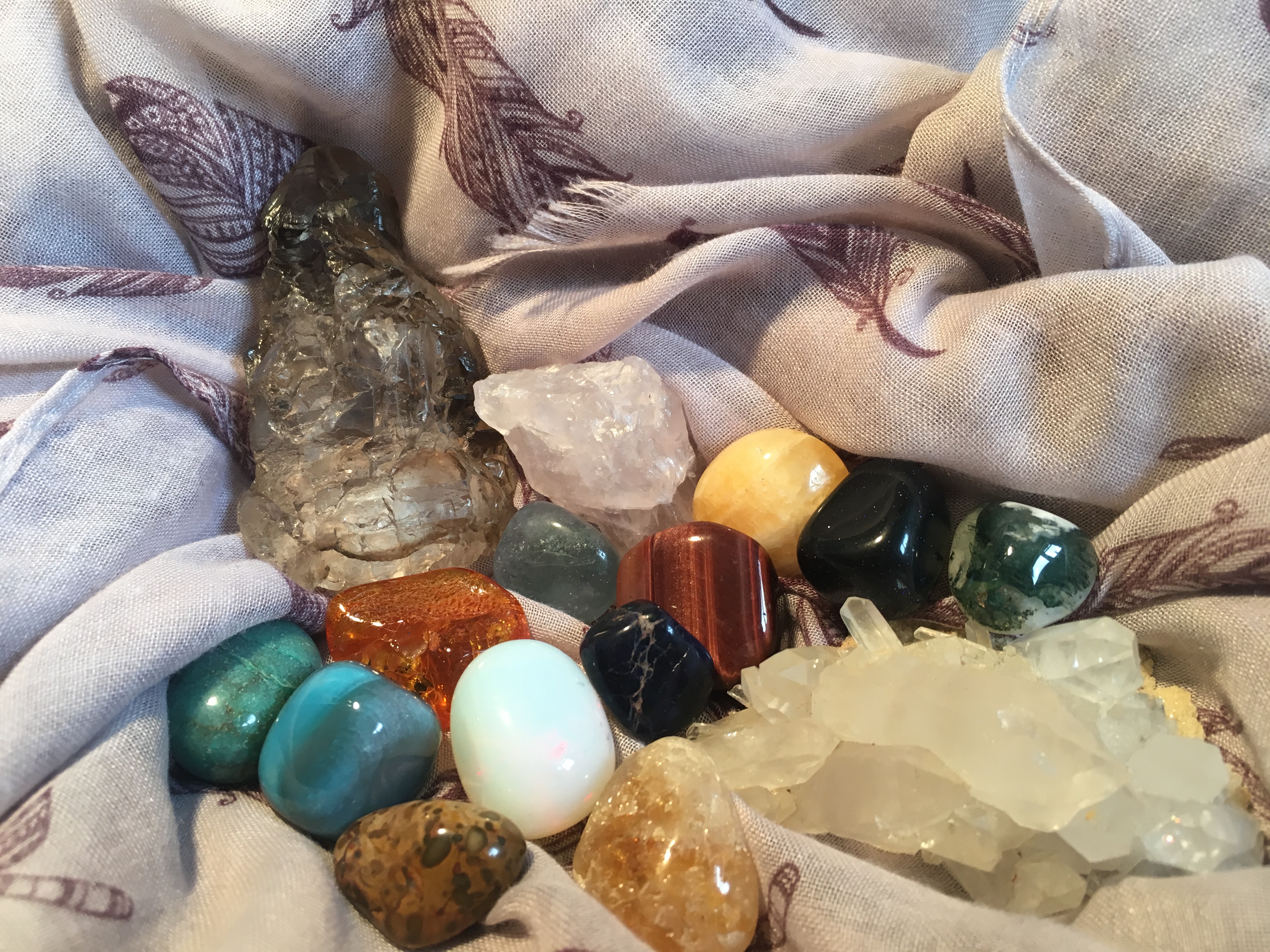
Some of my collection.

Over time I have come to appreciate that, no matter which explanation is right, both natural and man-made crystals do tend to work well for me, and I stopped worrying about why that is. There are a few I particularly enjoy working with, but my method of choosing one for the day is random. All of my crystals are in their individual velvet bags, tucked away in a box. When I feel I need something ‘extra’, I pick a bag my hand is drawn to without looking. Interestingly, I found that the properties of the stone I choose reflect what I need that day, for example randomly choosing a red tiger’s eye when I’m feeling low in energy. I also really enjoy meditating with them and I’ve had some wonderful experiences with personal gnosis about their properties. Admittedly these may sometimes differ from the standard properties discussed, but it works for me. Maybe this comes down to the relationship with the individual crystal or spirit? Either way, I know that I will happily continue exploring my crystal journey for a while longer.

References:
David, J., Heath, V. (2013). Tiers of Light. Shrewsbury:The Torch Publishing.
Hall, J. (2009). The Crystal Bible Vol.1. London: Octopus Publishing Group Ltd.
Brown, D. (2007). Beginner’s Guide to Crystals. Leicester: Silverdale Books.

Jurate

Deep in the cold waters of the Baltic Sea there was once a lavish castle, made entirely of amber, and ruled by the beautiful queen Jurate. Jurate was a sea goddess, and some say a mermaid. She was also prone to fits of bad temper, often punishing those who disturbed the sea-life under her command. Local fishermen would make annual offerings of fish โ€“ one of each kind โ€“ to calm her stormy moods. If they were foolish enough to forget the offering, Jurate would release her czetlice to punish them. Czetlice were stunning mermaids, with snow-white skin and long hair, half naked in their fish scales. They would sing their song, luring unsuspecting fishermen into the icy water, and once the fishermen were crazed with lust, they would crush them with their deadly embrace:

Oh young, handsome fisherman
leave your nets, come aboard
here we’re always dancing, mating
our singing will sweeten your sorrows.

A statue of Jurate in Jurata, Poland.

One day, Jurate came across one such young fisherman, Kastytis, who was catching too many fish, disrupting the balance of the sea. She was planning on punishing him, but once she saw his handsome face she immediately fell in love. The two became lovers and would spend a lot of time together in her amber castle. Unfortunately the match was not approved of. In some versions either Perun or the unnamed king of the sea destroys the castle in a jealous rage, either by lightning or a quake.

What happens to Jurate after varies from version to version. In the most optimistic stories, Jurate manages to save Kastytis from under the rubble, bringing him back to the shore safely. A less fortunate ending tells of the lovers meeting their end in the collapsed structure, while another version tells of Jurate being chained to the ruins as punishment, mourning her lover ever since. Regardless of the ending, it provides a reason for why the Baltic Sea still brings ashore pieces of amber, as they are either all that remains of the once magnificent castle, or tears that Jurate cries in mourning.


Adapted from Bestiariusz Sล‚owiaล„ski (2018) by Witold Vargas and Paweล‚ Zych.

Rosemary

Rosemary (Rosmarius Officinalis) is another common herb you may find in your garden, or at least in your spice cupboard. Its Latin name means โ€œsea-dewโ€and may refer to the plant’s appearance and preference to grow close to the sea.

Rosemary tends to be easier to cultivate from cuttings than from seeds. It needs a well-drained soil and a sunny spot in the garden. Don’t cut it back in autumn as it may not recover during frosts. It’s unlikely to suffer pests and can be harvested all year round (McVicar, 2010).

There are a few Christian legends associated with the plant. In one of the stories the plant gains its fragrance when Virgin Mary spreads baby Jesus’ clothes on its bush to dry. In another story Mary was resting during her journey to Egypt and hung her robes on a rosemary bush. When she removed them, the previously white flowers have turned blue (Linford, 2010). In a different version of the story Mary was hiding from soldiers, kneeling behind a rosemary bush with her cloak spread over it (McVicar, 2006).

My potted rosemary.

Rosemary is linked to memory and remembrance, as mentioned in Shakespeare’s โ€œOpheliaโ€. It is also seen as protective against evil in many cultures, and symbolic of friendship and love (Linford, 2010). Couples would carry rosemary as a sign of fidelity in Elizabethan times. Throughout history it was often used to freshen and cleanse air during sickness (McVicar, 2006), which links to its protective and cleansing qualities.

Rosemary essential oil has anti-bacterial and anti-fungal properties, and can be rubbed onto joints to help poor circulation. It can be applied externally to the forehead to aid headaches, or a few drops can be added to a bath to soothe muscles and help lift mood, however it should not be used internally. Rosemary tea, on the other hand, can be drunk in small doses to aid digestion or used as mouthwash. Care should be taken, as extremely large doses of rosemary can be dangerous and have the potential to cause abortions and convulsions (McVicar, 2006; Plucknett,1996).

Traditionally, we can see that rosemary was used for love and fidelity, thus we can incorporate it in those spells if needed, or hand-fasting rituals. There are also potent purifying and protective properties which can be used in smoke cleansing, protective charms and wards. This can include incorporating sprigs of the herb or anointing objects with its essential oil. Lastly it can be used to aid memory when studying, in spells linked to memory or learning, and by extension to aid dream recall.

References:
McVicar, J. (2006). Jekka’s Complete Herb Book. Leicester: Silverdale Books.
Linford, J. (2010). A Concise Guide to Herbs. Bath: Parragon Book Ltd.
Plucknett. J. (1996). Traditional Herbal Remedies. Bristol: Parragon Book Service Ltd.

Plant Spirit Ally Challenge

The month of May marked the beginning of the Plant Spirit Ally Challenge, hosted by Hagstone Publishing. I thought I would share some of my experiences of the event.

I chose African Violet as my ally to work with. This plant has accompanied me since my childhood, I had it throughout house moves, and at university. I thought it was about time I deepen my connection with it. The only downside of my choice was that many of the challenges required ingestion of a plant, which is not something advisable with this particular violet.

The challenge begins with relatively easy tasks, making it approachable. As the tasks increase in difficulty, you spend more time working with your ally and learning more about them. I found this really helps the relationship grow quickly as the focus is fairly intense when tasks are done daily.

Within the first week, I meditated with my violet, made offerings of crystal charged water and service, drew it, and overall gave it a lot more attention than I have for a while. I meditated with it again afterwards, and the experience simply did not compare. I received a lot more information from its spirit, regarding its use and properties, as well as spiritual correspondence. Some of it matched what I read online, such as using it to strengthen connection to the Divine, spiritual protection or love, but some of it was new, such as using it to help with divination. I also believe I was introduced to the archetypal spirit of the African Violet, which came as a bit of a surprise. This is the kind of personal gnosis that makes your practice more exciting and more personalised.

One of my replanted violet offshoots – part of the offering of service.

I must say, I particularly enjoyed researching lore then writing my own myths for the ally. Although it might seem a bit abstract, the process relies on your knowledge and understanding of the plant and its symbolism, allowing you to express them more creatively. My myth and poem were not very long, but they were personal to me. I still have a few outstanding tasks that I am planning to undertake at a later date. In some cases I’ve done the tasks but with a different ally, and I would very much like to repeat the process with different plant spirits.

Overall, this was a fantastic experience that brings tangible results very quickly. It propels you into a novel approach of getting to know your ally, with fun activities that allow you to form a much closer bond. I would highly recommend it to anyone starting their journey with plant spirits, particularly since the challenge can be approached flexibly in terms of preferred tasks and the time frame, while still keeping you motivated. The materials and the accompanying guide can be found here. I hope that you, dear reader, will give it a go (if you haven’t done so already) and discover the joy it brings.